Booking choice: The small-group Cathedral tour, from $48 per person. Check dates Tour details
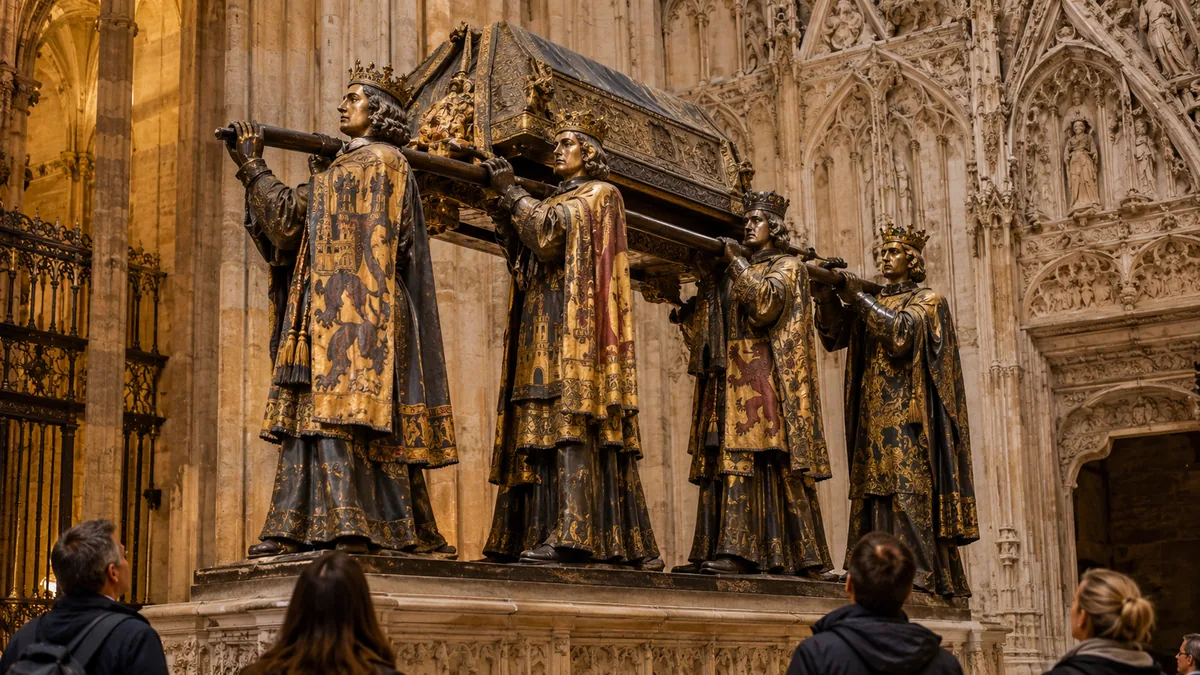
Christopher Columbus died in Valladolid in 1506, and his bones travelled more than he did after that: to Seville, to Santo Domingo, to Havana, and back to Seville in 1899. Since 1902 they have rested in the monument by Arturo Mélida, near the south door of the Cathedral.
The tomb is where most visits start, but it is a small part of the building. This guide covers the tomb and the DNA story, then the other big sights, and ends with a route that links them.
The quick answer
Yes, Columbus is buried in Seville Cathedral: DNA studies led by José Antonio Lorente of the University of Granada confirmed in 2024 that the remains are his. The tomb, by Arturo Mélida, came from Havana after Spain lost Cuba in 1898 and has stood just inside the Puerta del Príncipe since 1902. Give the tomb ten minutes, then the main altarpiece, the choir, the sacristies, the Chapter House, the Giralda and the Patio de los Naranjos.
Is Christopher Columbus really buried in Seville Cathedral?
Yes. The remains in the tomb were matched by DNA to his son Hernando and his brother Diego, and the research team declared the identification definitive in October 2024.
The remains moved several times after his death in 1506. They went to Seville, then to Santo Domingo in Hispaniola in 1542, then to Havana in 1795 when Spain ceded the island, and back to Seville after Spain lost Cuba in 1898. The Cathedral's sculpture history dates their arrival in Seville to 1899.
Santo Domingo still claims to hold Columbus too, from a casket found there in 1877. The Seville bones are only part of a skeleton, and some historians think both cities may hold part of him. Guests usually leave with that story: "He was a traveler, even in death!"
Who made the Columbus tomb, and what does it show?
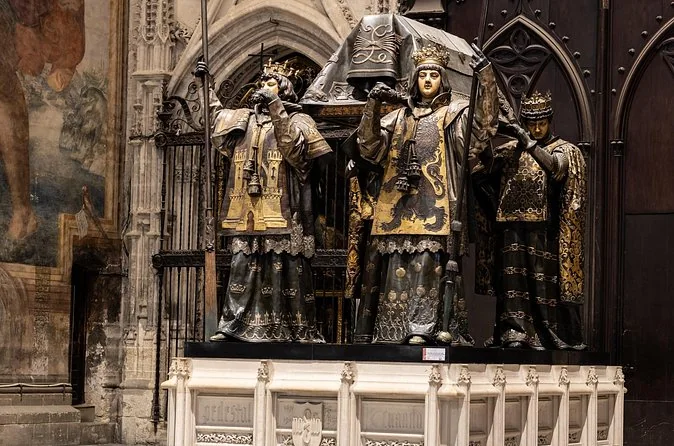
Arturo Mélida designed it in 1891 for Havana Cathedral. Four heralds in tabards bearing the arms of Castile, León, Aragón and Navarre carry the coffin on their shoulders.
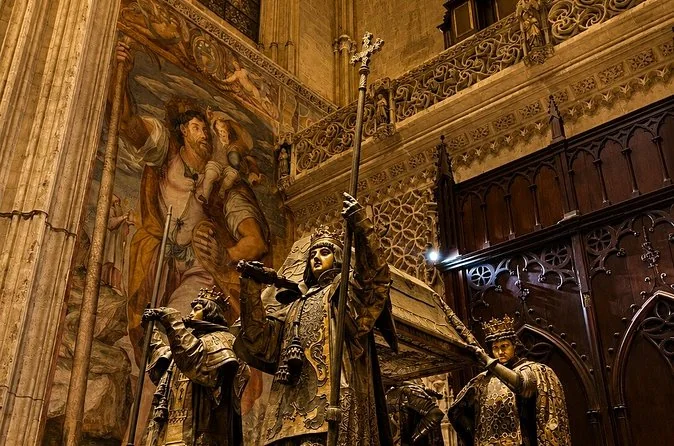
The monument crossed the Atlantic with the remains and was set up in Seville in 1902, according to the Cathedral's history timeline. The four figures stand for the kingdoms of Spain at the time of the 1492 voyage. Guides like to point out that the two at the front, Castile and León, hold their heads high, while Aragón and Navarre behind look down; Castile's lance pierces a pomegranate, the symbol of Granada, taken in the same year Columbus sailed.
It stands in the south transept, right by the Puerta del Príncipe where the cultural visit enters, so you will see it in your first minutes inside. Look for the painted Saint Christopher, a huge mural on the wall nearby.
What did the Columbus DNA studies find?
A team led by José Antonio Lorente of the University of Granada worked on the remains for more than 20 years and, in October 2024, confirmed they belong to Columbus.
The tomb was opened in 2003 so that samples could be taken. The bones were compared with those of Hernando Colón, Columbus's son, who is buried in the same Cathedral, and of his brother Diego. Labs in Spain, the United States, Mexico and Italy took part, and Lorente announced that "the previous partial theory that the remains of Seville belong to Christopher Columbus has been definitively confirmed" (Archaeology Magazine).
The same 2024 programme made claims about where Columbus was born. Those claims are disputed by historians and geneticists, and nothing about them changes what lies in the tomb.
What is special about the main altarpiece?
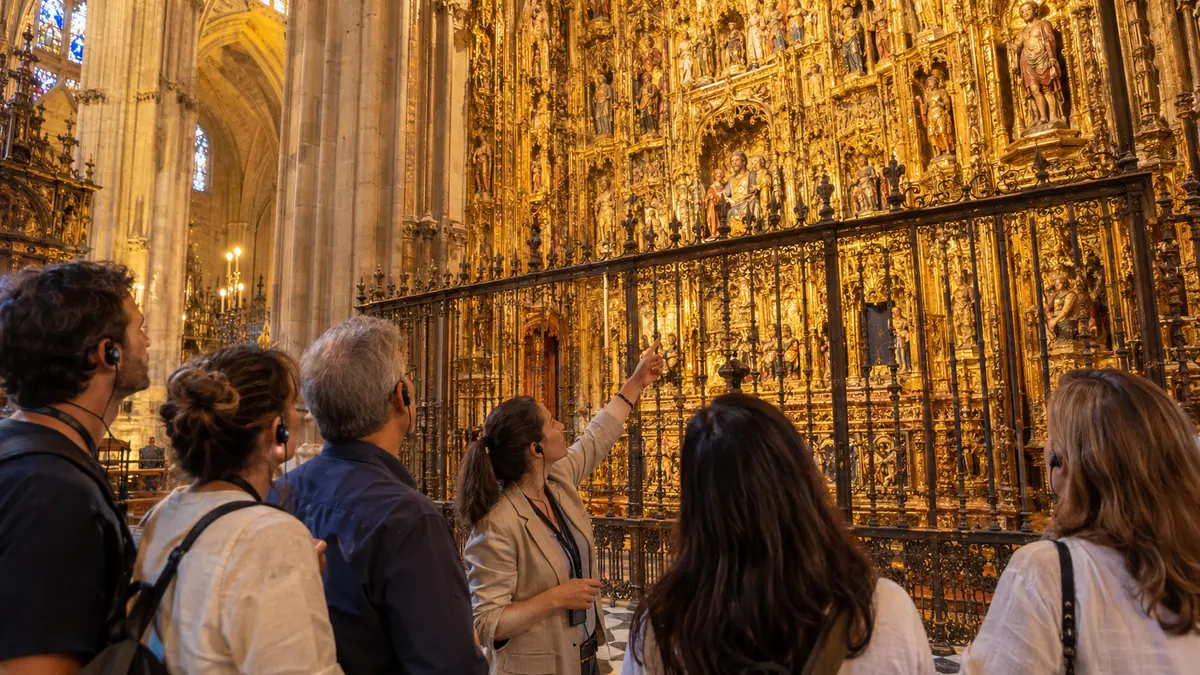
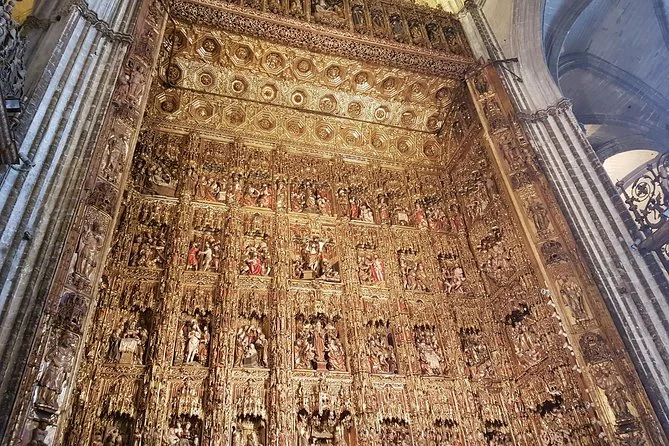
It is the largest altarpiece in Christendom, according to the Cathedral: nearly 30 metres high and 20 wide, with 44 carved scenes and more than 200 figures, made between 1482 and 1564.
The Flemish sculptor Pieter Dancart designed it in 1482, and Pedro Millán, Jorge and Alejo Fernández and others carried it on until 1564, as the Cathedral's description sets out. Read it in rows: the life of the Virgin and of Christ, from the Annunciation at the bottom to Pentecost at the top. At the centre of the base sits the Gothic Virgen de la Sede, who gives the Cathedral its name, and the base reliefs include views of old Seville.
On a normal ticket you see it through the great grille of the Capilla Mayor. The Cathedral's EUR 20 guided visit takes you inside the chapel: see guided tour or audio guide.
What should you see in the choir?
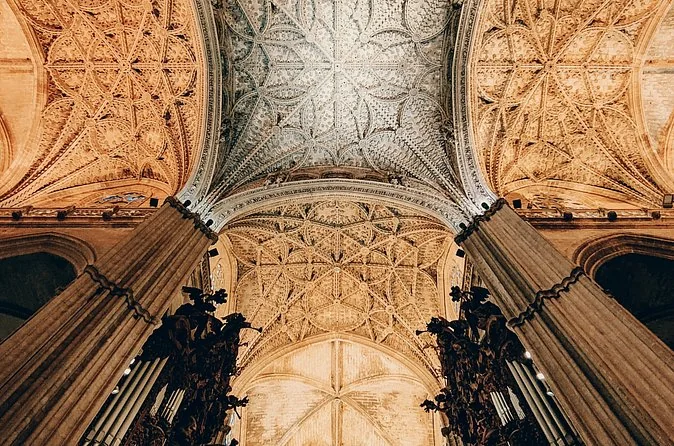
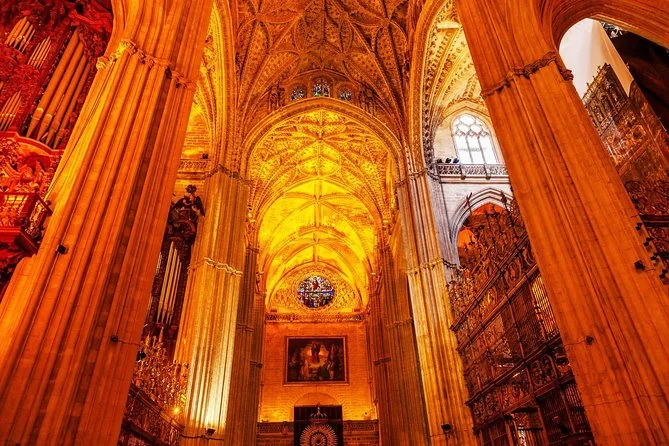
The 117 carved Gothic-Mudéjar stalls, a Renaissance grille made between 1518 and 1523 and two great organs. The choir faces the Capilla Mayor across the crossing.
Fray Francisco de Salamanca made the grille. Inside, the stalls were begun by Nufro Sánchez, whose signature and the date 1478 are on the king's seat, and finished by Pieter Dancart's workshop. Look at the misericords if you get close: monsters standing for the vices. The organ cases tower over the side walls; the present organs were completed in 1903.
On the standard visit you look in through the grille. On the official guided visit you walk inside.
What is in the sacristies, the Chapter House and the treasury?
A Goya, Murillos and Zurbaráns, the silver monstrance by Juan de Arfe, and an oval Renaissance meeting hall built for the Chapter.
- Sacristía de los Cálices: Goya's Saints Justa and Rufina, the city's patron saints, delivered in 1818 (Fundación Goya en Aragón).
- Sacristía Mayor: the treasury. Its star is Juan de Arfe's processional monstrance, accepted as a model in 1580 and finished in 1587, per the Cathedral's goldsmithing page. It still goes out on Corpus Christi.
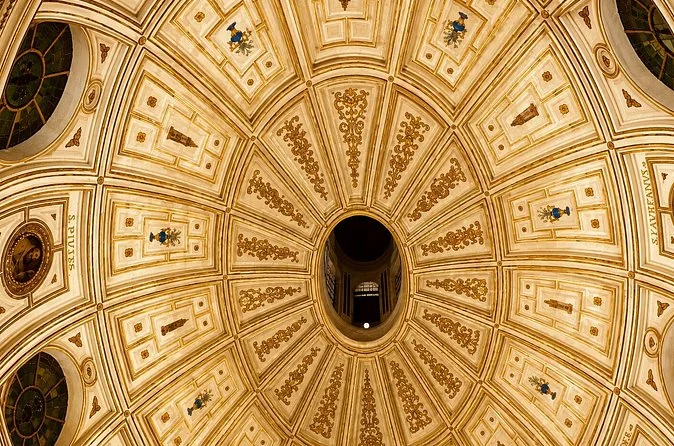
- Chapter House: an elliptical hall begun by Hernán Ruiz II and finished by Asensio de Maeda, designed so every canon could see and hear the others. Murillo's Immaculate Conception hangs high above the seats. The Cathedral's page explains the moral programme on its walls.
- Capilla de San Antonio: Murillo's Vision of Saint Anthony of Padua. In 1874 thieves cut out the saint and sold him in New York; he came back and was set into the canvas again (the painting's history). Look for the join.
Two hours in the Cathedral with a licensed guide and ten people at most: the tomb, the altarpiece, the sacristies and the Giralda. Non-refundable once booked.
Explore the small-group Cathedral tour Tour detailsWhat is the Patio de los Naranjos?
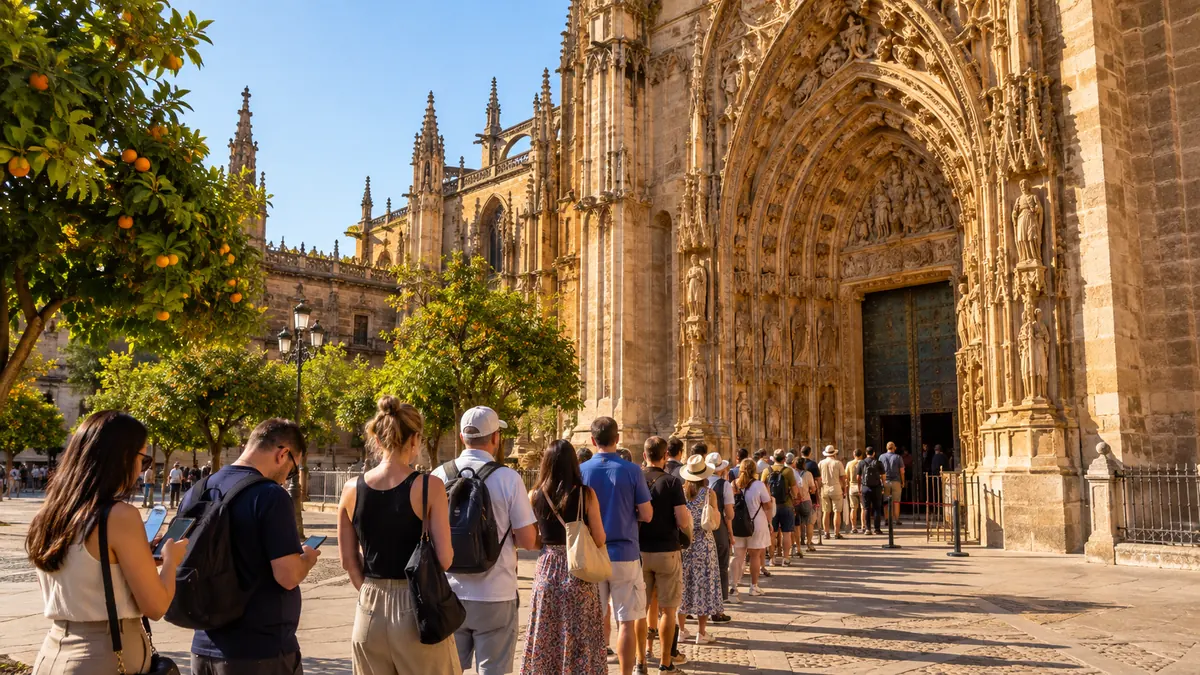
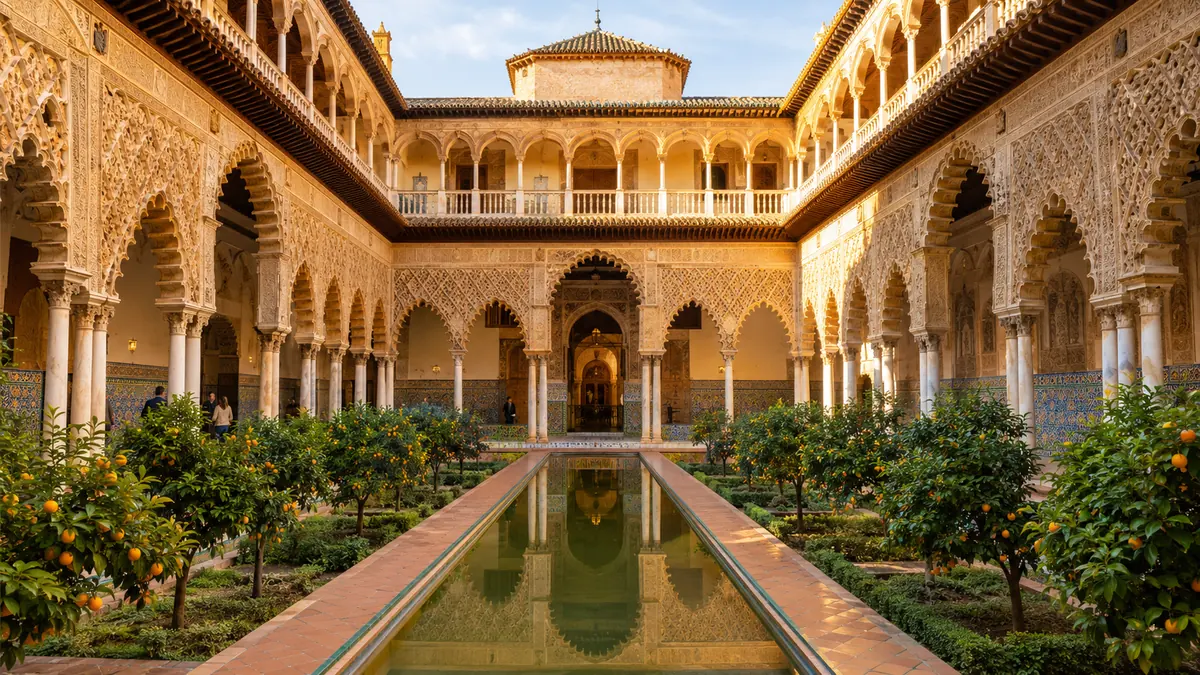
The courtyard of the 12th-century mosque, planted with orange trees and still watered by the old channels. You leave the Cathedral through it and the Almohad Puerta del Perdón.
The Cathedral's page on the Patio notes that the upper bowl of the central fountain is Visigothic and served the mosque's ablutions. Above the northeast galleries sits the Biblioteca Colombina: the books of Hernando Colón, Columbus's son, including 940 incunabula and about a thousand manuscripts. Look up at the Puerta del Lagarto for the wooden crocodile that hangs there.
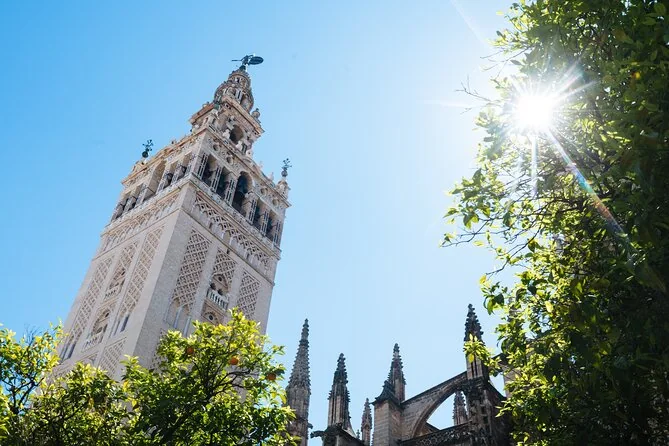
The exit through the Puerta del Perdón is the last piece of the mosque you walk through. Turn round on the street outside for the Giralda framed in its horseshoe arch.
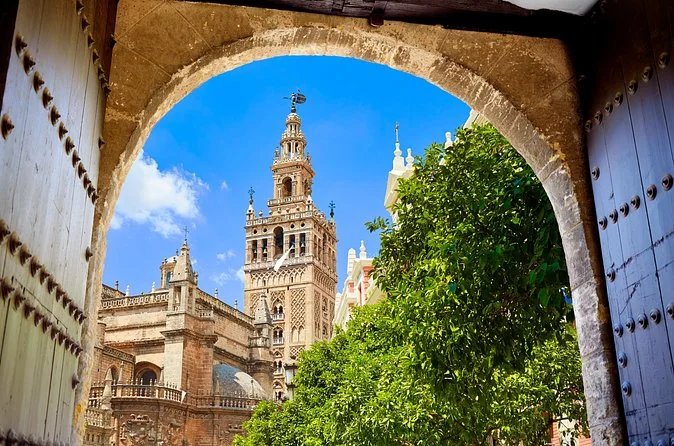
What is the best route through Seville Cathedral?
Columbus tomb, sacristies and treasury, Chapter House, the altarpiece and the choir, the Murillo in San Antonio, the Giralda, then out through the Patio de los Naranjos.
- Puerta del Príncipe: the Giraldillo replica outside, then straight to the Columbus tomb.
- Southeast corner: the Sacristía de los Cálices (Goya), the Sacristía Mayor (Arfe's monstrance) and the Chapter House (Murillo).
- The crossing: the main altarpiece through its grille, then turn round for the choir and the organs.
- The north side: the Capilla de San Antonio and the Murillo, and Hernando Colón's tomb slab in the nave floor towards the west doors.
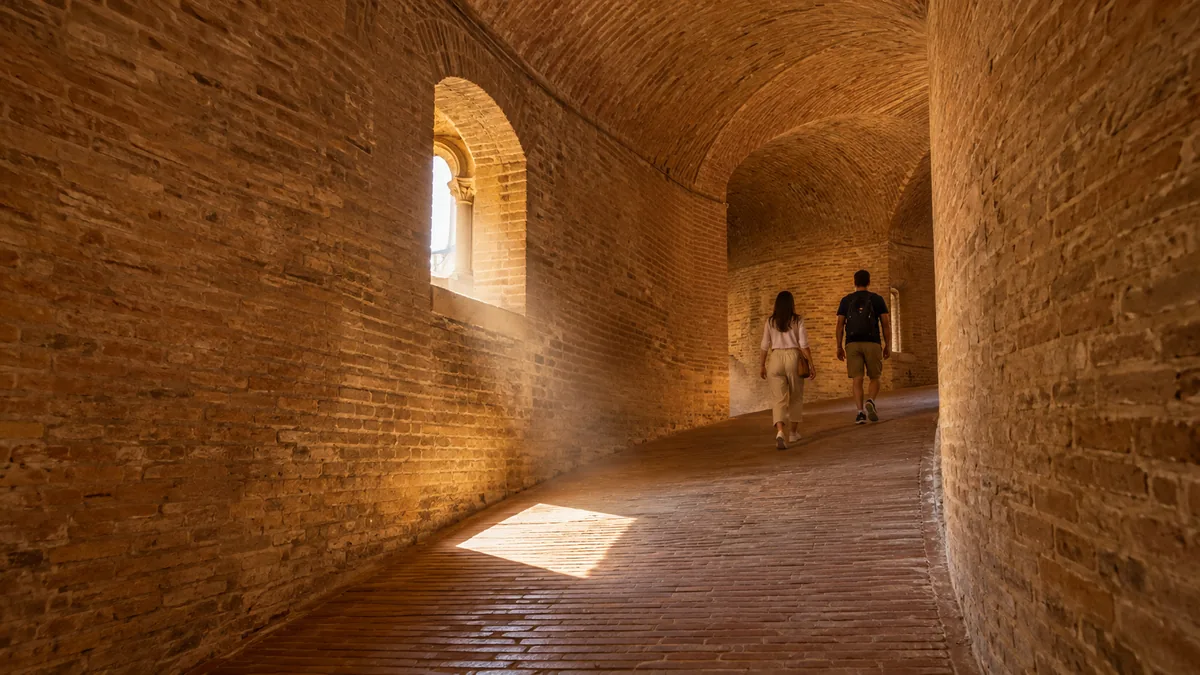
- The Giralda: 34 ramps up, the bells, the view. Many groups climb first instead; it depends on the queue.
- The Patio de los Naranjos: the fountain, the oranges, the Puerta del Lagarto, and out through the Puerta del Perdón.
Allow about 75 minutes, the Cathedral's own estimate, or two hours to see the paintings properly. Wear something with sleeves: the dress code is checked at the door.
All of it with a guide and ten people at most: two hours, rated 5.0 by guests.
Check dates for the small-group Cathedral tourFrequently asked questions
Where is the Columbus tomb in Seville Cathedral?
In the south transept, just inside the Puerta del Príncipe, where the cultural visit enters. It is one of the first things you see.
Is Columbus's son buried in Seville Cathedral?
Yes. Hernando Colón, the son who founded the Biblioteca Colombina, is buried in the Cathedral under a slab in the floor of the nave. His DNA was used to identify his father's remains.
Can you visit the Capilla Real?
Not on the cultural visit. The regulations reserve the Royal Chapel for worship and prayer.
Do I need a guide to find the Columbus tomb?
No. It is right by the entrance and marked. A guide or the EUR 4 audio guide adds the story of the remains and the DNA tests.
Ready to book
Choose your tour
Check the refund terms on each card: some of these tours are non-refundable. Prices are from-prices in USD and move with the season.
Small-Group Cathedral & Giralda Tour
- Cathedral and Giralda entrance ticket
- Licensed guide in English
- Radio headsets when needed
Cathedral & Giralda Guided Tour
- Cathedral and Giralda entry
- Skip-the-line entrance with your guide
- Local guide in English, with headsets